Friday, April 23, 2021

Buy Sarees Online : Baluchari Sarees

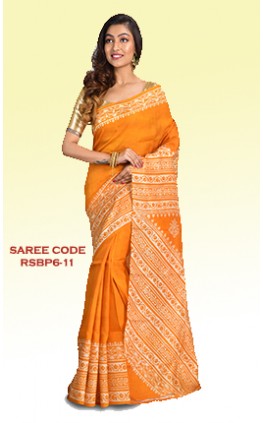
Baluchari Saree is a unique product of Bengal which has created its own global identity because of its intricate designs and craftsmanship of weavers of Bengal.


Baluchari Saree is a handwoven saree using richly dyed silk, with intricate motifs that depicts tales and scenes from ancient epics and religious texts.
The art of Baluchuri was brought from Dhaka (in present day Bangladesh) to a small village named Baluchar on the banks of river Bhagirathi in Murshidabad district of West Bengal by Murshidkuli Khan, Nawab of Bengal, in the 18th century. Thereafter because of natural calamities the weavers of Baluchari Sarees relocated to Bishnupur in Bankura district of West Bengal. However, subsequently during British Rule, the trade was brought almost to the verge of close down as the British felt threatened by their inability to replicate this craftsmanship in their mills. In the mid 20th century the revival of Baluchari weaving was brought about by the artist Subho Thakur, who was instrumental in developing the technique of jacquard weaving which greatly simplified the process and reduced the time taken for weaving one Baluchari Saree.

At present, the Baluchari Saree has been granted the status of Geographical Indication (G.I) in India.

Thursday, April 8, 2021

Pure Silk Saree - Buy Pure Silk Designer Sarees Online From Resham Shilpi

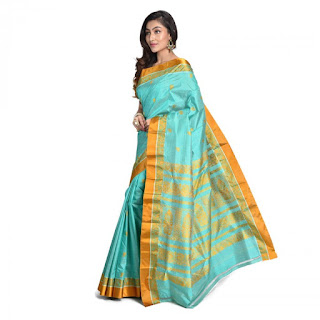
Weddings have a prominent spot in the Indian way of life and the traditional Pure Silk Saree expect vitality for such an awesome event. The wedding Pure Silk Saree with all its delicacy and trappings is remarkably arranged and made for the significant occasion when vows are exchanged, new associations are made and a fresh voyage into life begins for the wedded couple. The Indian pure silk sarees are known for their luminous beauty and peerless variety of designs and colors. These sarees are known to be the traditional bridal wear for most Indian brides. 


The Pure Silk Saree, ordinary attire for most Indian women; a national heritage, has today anticipated the element of a structure clarification. Indian weddings are remarkable occasions when the Pure Silk Saree is appeared in the aggregate of its parts of collection, extravagance, sumptuousness and one-upmanship.

Pure Silk Saree has dependably been a prevalent texture yarn in all edges of India where mulberry and different types of silk like Muga, Eri, Tussar are developed. Customarily handloom Pure Silk Saree have dependably been utilized for exceptional events like weddings, customary celebrations and as marriage clothing. These days parties, critical get-togethers, corporate capacities have additionally turned into those select events implied for the utilization of silk handlooms.


North or South, East or West, Pure Silk Saree is dependably the best, is the conviction of each Indian lady with the sponsorship of age old custom which considers it as a texture material of virtue from God's occasions.


How about we see which corner of India offers what for the woman who enjoys her Pure Silk Saree.

South Handloom Pure Silk Saree are acclaimed for their delicate feel, rich string work, appealing themes and examples, differentiate fringes in a wide scope of dynamic hues. No South Indian wedding or commemoration work is conceivable, even today, without the Silk 'Pattu' sarees being in plain view. The lady of the hour, the ladies in the family, relatives, visitors who visit, all show up in their radiant silk sarees of various assortments or customary styles. It is a fine presentation of new consolidations of plans, examples, hues and enhancing highlights like zardozi, ari, gota and different types of weaving, kundan work, reflect work, chamki work and so on.

There are a lot of conventional Pure Silk Saree handlooms in the south like Mysore, Kanjeevaram, Dharmavaram, Arani, Rasipuram, Venkatagiri, Coimbatore, Pochampally, Narayanpet, Bangalore, Uppada, Gadwal, Mangalagiri Silks. Bangalore and Mysore in Karnataka, India, are celebrated for their individual brands of silk, particularly the Mysore assortment, which has since long been loved for its one of a kind characteristics.

Kanchipuram or Kanjeevaram Sarees furthermore have an outstanding spot in the surface world. Like the Mysore Pure Silk Saree, the Kanchipuram Pure Silk Saree are made of unadulterated Pure Silk Saree, with subjects having zari of silk strings dove in liquid gold and silver. The interest of the Kanjeevaram Pure Silk Saree lies in the rich broad edges with shades and plans remarkable in connection to that of the body. Basic subjects are sun, moon, peacock, swan, lion and mango. Subjects like jasmine blooms scattered between cutoff points, parallel lines running transversely finished or haven structures are extremely common.


The Northern India clearly has the astoundingly old Banarasi Pure Silk Saree with its standard excellent delicacy and incredibly rich zari work in unadulterated gold that is a principal bit of the wedding, the sangeet work, the mehandi rasm, the social occasion and other fabulous occasions like get-togethers, festivities like Deepawali, Dushhera, Holi, etc.

Chanderi Pure Silk Saree of Madhya Pradesh (MP), are known for their sheer quality, fine surface and wonderful work in craftsmanship and structure. Chanderi Silks have zari brocades with weaving of various examples as Zari, Zardosi, Ari, Gota, Chikan, to give some examples. Tussar Silk, otherwise called 'Kosa' Silk is 'wild silk', of a profound brilliant shading and great surface, and is from the timberlands of Jharkhand, Chattisgarh. This fine silk yarn otherwise called Vanya silk is what is accessible for the tribals to demonstrate their masterfulness and craftsmanship close by painted topical workmanship in eco-accommodating hues and outlandish batik, sharp and point by point smaller than expected portrayals on well-woven Tussar Silk textures, known for their zari fringes, themes and the hand created structures that advance them.
urning eastbound we run over Bengal, Bihar, Orissa, the North Eastern states, smooth contributions which are a fundamental piece of weddings. Assam Pure Silk Saree, produced using Muga (brilliant Pure Silk Saree), Mulberry Pure Silk Saree or Eri Pure Silk Saree with Pure Silk Saree work or multi-hued strings with examples like organic products, blossoms, precious stones, creatures, fowls as themes. Meghalaya is outstanding for its handloom woven textures in. Meghalaya silks in Eri, endi and now and again mulberry silk are known for their toughness and surface, offering canvas for delightful eye-getting examples of zari in zardozi, chikan, ari and gota. Design prints of batik, square, bandhini lehriya, decorations with kundans, dabs, and pearls, together add to the charm of the Meghalaya Silk texture.


Bengal is popular for its handloom Pure Silk Saree – fine, smooth, of good surface, vaporous and

light on the body. Well known for the solace Bengal Silks are favored in shades of red, green, yellow, blue and their shades. Pure Silk Saree brocade plans fit to the base shading, are brightened with appealing themes. Jamdhani hand weaving is a fundamental backup for Bengal textures where cotton and gold string weaving make themes of geometric examples and flower plans in vivid tones. Dhania Khali and Thangail are prominent weaving styles, Nature, the sun, the moon and stars being a portion of the well known themes.

Western India has a lot of wedding silks in the acclaimed Paithani sarees in unadulterated Pure Silk Saree and stunning brilliant zari with twofold shading, shining impact and a stupendous peacock embellished pallu. Other than this lively offering from Aurangabad, Maharashtra, the hair-raising silks of Kota with their fine check weaves and the luxurious stories of Rajkot in stunningly planned renditions are different pleasures.


For all assortments referenced above, and under a solitary rooftop, Unnati with a relationship of three decades with ace weavers and their specialty has everything and significantly more.

– A social reason for advancing conventional greatness through the consolation of value handloom in fine Pure Silk Saree, cotton and other texture materials, –

– Providing open doors for weavers to exceed expectations in their art through splendid combination of customary and in vogue,

– Creating attention to India's rich legacy in handloom textures through novel, inventive and moving manifestations from all sides of India at alluring costs discount and detail,

the Unnati energy and enthusiasm for conventional handlooms has not diminished but rather expanded complex in its encouraging forward.

Friday, February 19, 2021

Top 10 Secret Fashion Tips For Women

men are a beautiful and unique creation of nature. Sarees are one of the best outfits for a woman to look graceful. Silk Sarees are always in vogue and some specific kinds like Batik silk saree, Baluchari saree, Kantha stitch silk saree, are always in style. To carry yourself in style, we offer some key tips. Keep them close to your heart…
Silk sarees


  1. Pre-planning: Plan before going out. Always keep a Silk Sarees as an option in case you have a last moment change of mind
  2. Collab with accessories:It will make you feel complete.
  3. Find your inspiration: If you are confused, check out your favourite insta fashion icon and follow accordingly.
  4. Explore more:Keep trying traditional sarees like Block printed silk sarees, Tasar sarees. They are safe for a wide range of occasions.
  5. Carry a signature shoe: Shoe portrays the first impression to give others depression.
  6. Own a Wow piece: Any of your piecesthat you wear should be ‘wow’ factor which could be discussed behind you and make other jealous.
  7. Know your shape:Don’t hesitate whatever your shape is. What you are is not body, it is in your mind.
  8. Be confident: Ensure yourself of looking pretty.
  9. Invest in a capsule wardrobe: Your closet should have a set of evergreen jewellery, all-time favourite Sarees; things can help you in urgency.
  10. Don’t forget to wear a smile:Yes, it is mandatory.

Thursday, February 4, 2021

Silk Sarees - That Keep Making You Fall in Love | Resham Shilpi


Well, that is what male and female both say. Men fall in love to see their loved ones in Silk Sarees. And ladies fall in love with Silk Sarees.
Silk has been passion, enigma, and economy for India since historical times. Traders and businessmen fell in love with India and Indian Silk and Chinese Silk. So much so that an entire travel route across various terrains was created for Silk trade, called Silk Route.

In modern times, silk is not less interesting, especially when unique designed Silk Sarees enhance the charming ladies across the globe.   Pure Silk Saree is a phrase that makes you fall in love!
Silk weaving, and creating the best of Mulberry Silk has been a strong domain of Bengal. West Bengal government, in an effort to strengthen the silk weavers’ cooperative, has created a brand for them -RESHAM SHILPI. You want a Silk Saree or call it a Pure Silk Saree, you want a Batik Printed Silk Saree of the famous Baluchari Saree, name the kind of silk and you get it at Resham Shilpi.
Online sale of Resham Shilpi Silk Sarees, Silk Dupattas and Silk Dress Materials are happening over the e-commerce website reshamshilpi.in. The products are delivered all over the world with free shipping. Resham Shilpi Products are also available in brick & mortar stores across West Bengal in 9 stores.
Whenever you purchase a Resham Shilpi Silk Saree or any other product, you benefit the silk weavers’ cooperative in West Bengal.  And you are assured of the quality.
If you are in love with Bengal, in love with your near and dear ones or in love with just Silk, you ought to purchase Resham Shilpi silk.

Monday, April 13, 2020

Garad Saree: Silk Sarees From West Bengal | Resham Shilpi


Garad” silk is traditionally woven by Bengal weavers in the district of “Murshidabad”, in West Bengal. “Garad” means white and it is woven with de-gummed undyed silk yarn. Hence, Garad sarees are usually of the natural colour of mulberry silk.
Green Garad Saree
Bengali women, generally, wear a Garad Saree in some festive occasion or during religious ceremony. Silk yarn used to weave Garad sarees is not dyed which keeps the purity factor of the fabric intact and therefore these sarees have a sacred importance to the women in Bengal. Tracing back the history, one would fine that the kings and zamindars in ancient times used to drape themselves in Garad clothes to perform religious ceremonies and rituals.


The traditional Bengali saree, Garad or Gorod is distinguished by a plain red border on a white or off-white silk body. Variations of the traditional Garad saree come with striped borders and fine motifs along the body. However, these days Garad sarees are being woven with dyed yarns also for providing some colour variations.
Off White Garad Saree
At present, the matter of granting Garad Saree the status of Geographical Indication (G.I) in India is under process.

Saturday, April 11, 2020

Buy Shibori Sarees Online at Best Prices

The term “Shibori”   is simply the Japanese word çµžã‚Š, which translates as to wring or squeeze, and in the crudest term can be described as the traditional, Japanese incarnation of tie-dye.
Tasar Shibori Saree


Originating in China, “Shibori” dyeing became popular in Japan during Edo Period from the 17th – 19th centuries, as people from lower social classes then needed an alternative to the silk they were banned from wearing. However, the earliest examples of Shibori textiles date all the way back to the 8th century when Emperor Shomu, the 45th Emperor of Japan, included a piece of shibori dyed cloth in a collection of items donated to Nara’s Todai-ji Temple. As time progressed, new variations of the technique came into being. There are six standard traditional “Shibori” techniques:——KumoShibori, Miura Shibori, KanokoShibori, ArashiShibori, Nui Shibori and ItajimeShibori.
Tasar Shibori Saree
“Nui Shibori” is the most detailed of all the Shibori techniques and it is as much about stitching as it is about dyeing. Hand stitching techniques and wooden dowels are used to create resists and then the fabric is dyed, the outcome of which is carefully crafted intricate designs with accurate patterns.In Resham ShilpiShibori sarees are made with purest quality of tasar fabrics following the technique of “Nui Shibori”. The artisanal handcrafted quality of the process makes each saree an unique piece.

Friday, November 15, 2019

Some of the Prominent Benefits of Buying Your Saree Online 2020


We live in a world where almost everything is available online and lifestyle has become much easier. People don't have to go to a lot of places in order to find that one perfect thing for them. Instead, they can just search it online and buy it from there. Sarees are also available online for you to choose from and buy. Silk sarees, Tasar saree, batik silk saree, baluchari saree, block printed silk saree, Kantha stitch silk saree and so on are available online.

 Silk sarees


The best part about buying silk sarees online is the variety that you get to choose between. Going to a shop would not give you as much variety as any online shopping website would give you and you can choose according to your preference, use, and mood. Also, this is not the only reason why you should buy silk sarees online. There are a lot of brands that are available on any online website and if you find your favorite brand in them, there are huge chances that you would not be disappointed with the collection.
Silk sarees

Most of these websites have a lot of sellers which is why there are a number of types of sarees. All the mentioned types of sarees will be available once you go to an online website to shop them.

Also, a lot of people are afraid of buying things online but that is one of the fears they should definitely let go of. This is because the generation is evolving and most of the people are ordering stuff online rather than going to shops and buying them. It is easier, convenient person does not even have to move out of their home to do so. All they need is a smartphone or a computer device and an Internet connection and that is just about it.

Sunday, October 27, 2019

Celebrate Diwali With Traditional Silk Sarees


Silk sarees have a presence of its own which is unmatchable by any other kinds of sarees. Diwali is also one of those occasions when everyonelove to come out in flying colors.
Silk and Diwali go hand in hand. There are many kinds of sarees such as Tasar saree, Batik Silk saree, Baluchari saree, Block Printed Silk saree, Kantha Stitch Silk saree from which a lady can choose from, and she can stand out in the crowd.
Silk Sarees do not only stand out but also they have that X-Factor that has the potential to look the best on anybody and that's the magic of silk sarees.


Celebrating Diwali in your own style is fun but shopping for it might be very hectic at times. Silk sarees online are available in many online shopping websites. The best part about online shopping is that the choice is huge. Various types of sarees are available on the websites. Ordering them easy and the delivery mechanism is efficient. You also save money in the process.
Many websites give amazing discounts during Diwali and it is the customers' wish to cash in on these offers or not. And some websites deliver free of cost.  There are government organisations who sell Silk Sarees procures from the weavers itself. They come with a guarantee of quality and delivery.

Friday, July 19, 2019

Cooperative movement for Sericulture to stride ahead


Paschim Banga Resham Shilpi Samabaya Mahasangha Ltd. (PBRSSM) was founded in 1956 under the West Bengal Cooperative Societies Act and the West Bengal Cooperative Societies Rules with the object of:
  • Improving traditional rural silk industry of WestBengal and promoting silkworm rearing, silk reeling, weaving of silk fabrics
  • Dyeing and printing of silk fabrics procured through member societies with the aid and guidance of the MSSE & T, KVIC and other organizations connected with the promotion and development of the silk industry
  • Organizing and developing the market for silk goods and handicrafts within or outside the state and abroad
Silk sarees


     The PBRSSM Ltd has at present nine retail outlets of which six are in Kolkata and three in the districts at Siliguri, Barasat and Durgapur.

The organization procures Silk, Matka, Tasar raw materials (kora thans) from Primary Cooperative Societies/ other enlisted societies. The fabric is then printed by enlisted printers. Self-help groups are also engaged for the embroidery works on Tasar, dyed silk. Also, Garad and Baluchari sarees are procured from primary cooperative societies and sold in the showrooms of PBRSSM Ltd.
The designs are based on traditional Bengal designs and also sourced from professional designers of the highest calibre. The mix of tradition and modern with an objective to strengthen the age-old industry in Bengal has worked wonders under the brand Resham Shilpi.
The sericulture farmers and the weavers are provided with credit cards
The Weavers Credit Card scheme was introduced with an aim to provide adequate and timely assistance from the Banking Institutions to the weavers to meet their credit requirement by providing credit at a concessional rate. Maximum limit to individual weavers is up to Rs. 2 lakhs. Normally no margin money is required for limits up to Rs. 25,000/- and 20% margin is required for limits above that.
So, when you buy a Resham Shilpi product, you are contributing to a greater cause and being part of a modern brand as well.

Monday, June 24, 2019

Buy Latest Bishnupuri Silk Sarees Online at ReshamShilpi


Bishnupur, (also called Vishnupur) is a town and area in the Bankura locale of West Bengal. It is named after Lord Vishnu, who was adored by the Malla rulers in the midst of the seventeenth and eighteenth many years and was the capital of the Malla kingdom.It is outstanding for its legacy of delivering silk sarees, particularly the sumptuous Bishnupuri Silk Saree the baluchari silk sarees. What's more, Bishnupur additionally creates fine, light-weight Bishnupuri Silk Saree  that have a delicate, smooth surface and wrap wonderfully.


History of Bishnupuri Silk Saree

Bishnupuri Silk Saree comes back to a couple of hundred years. It is known to have flourished in the eighteenth and mid nineteenth many years when the East India Company traded weaved scarves and organic surfaces for dresses made of fine Bishnupuri Silk Saree .

In the interim, around 200 kms away, in another silk delivering region of Bengal, Murshidabad, the weaving of the Bishnupuri Silk Saree  bloomed under regal support of the Nawabs of Bengal. The Bishnupuri Silk Saree  were settled on the banks of the stream Bhagirathi, however a flooding of the waterway made them evacuate themselves and move to Bishnupur. Exchange continuously declined under the British realm and the deluge of modest factory made texture from England joined with budgetary authorizes in the long run crushed the baluchari weavers out of their specialty.

The recuperation of Bishnupuri Silk Saree in the mid twentieth century was accomplished by the specialist Subho Thakur, who developed the method of jacquard weaving that staggeringly streamlined the system and reduced the time it took to weave a Bishnupuri Silk Saree . This new time of Bishnupuri Silk Saree weaving features subjects from adventures and religious messages, and is continued right up 'til the here and now by the weavers of Bishnupur.

Baluchari weaving, Bengal

Bishnupuri Silk Saree weaving continues being a basic lodge industry in Bishnupur, and about 15% of its people is used in the handloom territory today. Regardless, the region isn't genuinely suitable for silk sarees raising or mulberry improvement, and a huge bit of the unrefined silk used here begins from other silk making regions, for instance, Murshidabad and Malda. Despite Bishnupuri Silk Saree , unadulterated silk sarees with square printed, destructive printed and Bishnupuri Silk Saree structures are ordinary. These sarees are incredibly light and blustery and touch base in a variety of tones with ordinary similarly as whimsical structures. They are sensitive and easy to wrap and are sensible for both agreeable and formal wear.

Saturday, June 22, 2019

Buy Exclusive Hand Printed Batik Silk Saree


Batik silk saree prints conjure a specific sort of nostalgic heaven with it. One of the most seasoned types of printing, it has experienced a style makeover with creators vouching for its immortal magnificence. Batik silk saree is an unpredictable craftsmanship done by hands with exceptionally basic instruments.

It is a procedure of wax-opposing color connected to plans which are drawn on the texture. The connected wax opposes colors and consequently enables craftsman to shading specifically by absorbing the fabric one or different hues. The wax is later evacuated by bubbling water. It's a conventional workmanship which is enlivened and impacted by an assortment of societies.

Bengal is celebrated for its handloom Batik Silk Saree. Fine, smooth, of good surface, breezy and light on the body, the Bengal silk saree is favored for any event from day by day easygoing to customary events, social capacities to stupendous gatherings and weddings.


Why Batik silk saree is all around appreciated?

There are a couple of reasons why Batik silk saree has such overall interest. Such are the attractions of this craftsmanship that the outcasts visiting India continually get things of dress with Batik silk saree on them. The first of these attractions is the steady converge of different tones. Straightforwardly from regular tones like maroon, beige and darker to warm tones like red, orange and yellow similarly as cooler tints like green and blue, Batik silk saree gets a handle on all and makes the piece of attire overwhelming to the buyer.

Another clarification behind its popularity is the flexibility of surfaces that it will, in general, be worked onto. Cotton is an unprecedented option for summers while silk Batik silk saree clothing is proper for winter.

The last and possibly the most basic interest is the variety of ethnic Indian dress things that one can purchase in batik. Regardless of the way that dupattas, kurtas, and coats in Batik silk saree are generally sold, the substance of this claim to fame really emanates through in Batik silk saree print sarees.

Assortment of hues, designs and prints

Alongside an assortment in hues in Batik silk saree sarees, the significant draw factor of a Batik silk saree is in its diverse plans and prints. Frequently the body of the saree is colored in one shading which is supplemented by a complexity in the shade of the fringe and the pallu. Alongside a distinction in tints, the saree for the most part likewise has an intense theme on the pallu.

There is no deficiency of Batik silk saree plans that are exceptionally alluring and reminiscent of the way of life and custom of India. A standout amongst the most well known themes is of creatures like elephants or winged animals like the peacock. Blooms and leaves are additionally conspicuous and generally decorate the fringe. Whirls and round prints can likewise be found in the more present day adaptations of the Batik silk saree. These examples are not limited to being colored onto cotton but rather look similarly as excellent on Batik silk saree silk sarees.

Batik silk saree with pallu

Peruse through our segment of Batik silk saree for the selective and most wonderful accumulation and purchase Hand Batik silk saree. What we have focussed on is the brilliant utilization of hues in an offer to fuel splendor, energy in and around you. As you will see, we don't put stock in simply planning sarees; we trust in structuring bliss as well!!

Friday, June 21, 2019

Tasar Saree Has The Answer To Everything.

Tasar Saree

It is India. Festivities are constantly around the twist. In a party it is fundamental for your societal position that you rise. From a marriage to a religious festival, social gatherings are way of life for India. You have to rise in mood and in style. Saris will reliably be an incredible in such conditions and especially imperative is and will be the faultless Tasar saree. Tasar saree has a rich history and political hugeness in India's history. 

Origin of Tasar saree 

Tasar saree is made from silk worms found in the bark of oak trees all over South East Asia. It is weaved from different groupings of silk worms all found in different land zones. The cases are first dried in the sun and after that they are risen to remove silk yarn from it. This is perhaps the most basic bit of the whole technique. The foaming placates the packaging and close by the worms inside it, it changes the structure of goo into strings of unadulterated charm. Tasar saree is seen as a much completed variety of silk. It is less solid than the standard one and has a dull splendid shading to it. This sort of silk is found essentially in the forests and thusly Tasar saree is seen as a boondocks thing by many.

The Sari and its age 

Tasar saree is a hot most adored among people of Bihar and Bengal area. The major age of this saree happens in Bhagalpur. Bhagalpur has an industry of in excess of 100 crores place assets into Tasar saree age and this saree is reliably in extraordinary enthusiasm for the zones of Bengal and parts of Bihar. Tasar saree offers work to workers of in excess of 30,000 handlooms in the Bhagalpur domain.
Tasar saree

The Tasar saree itself is a thing of the tales. Bengali culture has made this saree basic, continually besting the outlines of style slants in every one of the events and get-togethers. Aside from Bengal, ladies in Maharashtra additionally wear Tasar saree on a semi customary premise. Presently on the off chance that we are discussing hues, you will locate a wide scope of hues in tussar saris. Going from beige to blue to brilliant to red. Likewise different kinds of plans are made with tussar silk. From Bengali kantha stiches silk saree to orissa's pattichatra, Tasar saree is utilized for all varities. The plans for the most part go from nature to precise geometrical structures.

Resham Shilpi brand which has texture and garments stores all over West Bengal in addition to they additionally have an online business site which has made the accessibility of these garments simple and inside the scope of a basic snap or a tap of the finger. You can look over their wide accumulation of conventional silk sarees and different sorts of texture to keep yourself ahead in the style amusement.

Thursday, June 20, 2019

Baluchari Saree


Since ancient times, Bengal has been famous for its textiles, and while it has been the fine cottons and muslins that have always been the region’s most prized exports, the Baluchari Silk Saree, with its elaborate weaves and visual narratives, is a stand-out. The story of this Silk Saree is closely linked to the history of Bengal.

The name Baluchari came into existence because the weaving of these Sarees started in a small village called Baluchar in the Murshidabad district of West Bengal around 500 years ago.


Baluchari Saree
Over time these weavers developed their own style of design that put this village on the world map.

Due to some natural calamities and the subsequent submerging of the village, the industry and the weaving setup was then  moved to Bishnupur village in Bankura district. The shift of the weavers from Baluchar to Bishnupur was also reflected in the Sarees they wove. The Sarees of this phase were highly influenced by the terracotta temples in this town, that was once the capital of the Malla Kings and there after the baluchari industry grew tremendously.

Manufacturing a Baluchari Saree is a time consuming process. It requires extremely good craftsmanship and takes around a week to weave one saree. These are hand woven and use the purest of yarns depending on the material. These sarees were originally woven only using the purest of silk threads.

Baluchari Saree
The Baluchari sarees are known for their intricate designs and handwork on them. No other saree uses as many mythological designs as the Baluchari sarees. Originally they are dominated by stories and characters from epics like Ramayana and Mahabharata. These characters give a royal look to the Baluchari Saree.

The mythological designs make a Baluchari saree perfect for ceremonial and festive occasions which have a religious touch to it.

Major steps are being taken today to revive the once lost tradition of Baluchari weaving around West Bengal and a big thrust is on making this a high fashion fabric relevant to younger generations. This seems to be working as the famed Baluchari once a staple in the wardrobe of zamindar households is making a comeback in the trousseau of young brides.

Baluchari Sarees


Since ancient times, Bengal has been famous for its textiles, and while it has been the fine cottons and muslins that have always been the region’s most prized exports, the Baluchari Silk Saree, with its elaborate weaves and visual narratives, is a stand-out. The story of this Silk Saree is closely linked to the history of Bengal.

The name Baluchari came into existence because the weaving of these Sarees started in a small village called Baluchar in the Murshidabad district of West Bengal around 500 years ago.

The history of Baluchari Sarees goes back to 1704 CE when Nawab Murshid Quli Khan, the Mughal Governor of Bengal shifted his capital from Dacca (present day Dhaka in Bangladesh) to Makshudabad (now Murshidabad in West Bengal). As the Nawab’s court shifted so did the network of artisans who worked for him. Murshid Quli Khan, brought to the new capital named after him, a number of weavers from Dacca, who were given their own space and settled in the village of Baluchar (Now called Jiaganj) located 9 kms from Murshidabad. The name Baluchari came into existence because the weaving of these Sarees started in the village Baluchar. Over time these weavers developed their own style of design that put this village on the world map.

Due to some natural calamities and the subsequent submerging of the village, the industry and the weaving setup was then  moved to Bishnupur village in Bankura district. The shift of the weavers from Baluchar to Bishnupur was also reflected in the Sarees they wove. The Sarees of this phase were highly influenced by the terracotta temples in this town, that was once the capital of the Malla Kings and there after the baluchari industry grew tremendously.

Manufacturing a Baluchari Saree is a time consuming process. It requires extremely good craftsmanship and takes around a week to weave one saree. These are hand woven and use the purest of yarns depending on the material. These sarees were originally woven only using the purest of silk threads.

Baluchari Saree
The Baluchari sarees are known for their intricate designs and handwork on them. No other saree uses as many mythological designs as the Baluchari sarees. Originally they are dominated by stories and characters from epics like Ramayana and Mahabharata. These characters give a royal look to the Baluchari Saree.

The mythological designs make a Baluchari saree perfect for ceremonial and festive occasions which have a religious touch to it.

Major steps are being taken today to revive the once lost tradition of Baluchari weaving around West Bengal and a big thrust is on making this a high fashion fabric relevant to younger generations. This seems to be working as the famed Baluchari once a staple in the wardrobe of zamindar households is making a comeback in the trousseau of young brides.

PASCHIM BANGA RESHAM SHILPI SAMABAYA MAHASANGHA LTD.


Paschim Banga Resham Shilpi Samabaya Mahasangha Ltd.[PBRSSMLtd.] is a State Level apex Cooperative Society which was registered on 26.01.1958 under the Bengal Cooperative Societies Act, 1940 with the following objectives:

i) To improve the traditional silk industry and to organise the silk weavers in Cooperative Societies
ii) To promote silkworm rearing, silk reeling & weaving of silk fabrics
iii) Dyeing and printing of silk fabrics procured from the members
iv) To purchase and supply raw materials, tools and equipments for members as and when required
v) To finance affiliated Societies
vi) To impart or arrange to impart business and technical training to members
vii) To provide facilities for the marketing of the finished products of the members of the affiliated societies in a profitable manner
viii) To organise and develop markets for silk goods within and outside the State of West Bengal and abroad

The Organization procures silk fabrics (mulberry & tasar silk) from Primary Cooperative Societies/other enlisted Societies/weavers and then add value to it in terms of Block/Screen print, Hand paint, Embroidery, Batik, Tie & Dye, etc. by enlisted Printers/Agencies. Self-Help Groups are also engaged for embroidery works on sarees.  Garad and Baluchari sarees alongwith other silk & tasar sarees with intricate woven designs are also procured from Primary Cooperative Societies. The designs are based on traditional Bengal designs and also sourced from professional designers of the highest calibre. The mix of tradition and modern with an objective to strengthen the age-old industry in Bengal has worked wonders under the brand Resham Shilpi.


The sarees, dress-materials and dupattas are then sold at 9(nine) showrooms of PBRSSMLtd. of which six are located at Kolkata and each at Barasat, Durgapur & Siliguri. So, when you buy a Resham Shilpi product, you are contributing to a greater cause and being part of a modern brand as well.
Resham Shilpi


For maintaining the high standard of quality of fabrics, these are first checked & approved by the Government Scientists & Technical Officers associated with Sericulture.
       
Alongwith maintaining the legacy of procurement & marketing of purest quality of silk & tasar fabrics Resham Shilpi also focuses on modernisation. The core business process of PBRSSMLtd. such as sales, purchasing, accounting & human resource management, etc. are managed by ERP software specifically designed & developed by National Infomatics Centre integrating all the showrooms with the Head Office.

Wednesday, June 19, 2019

Best Garad Saree's Store Now in Kolkata


Garad (otherwise called Gorod) silk is one of the mainstream styles of saree that has its source in West Bengal. Otherwise called Gorod, the word Garad signifies 'White'. Garad silk sarees are recognized by its red outskirt and little paisley themes. Silk texture used to weave Garad sarees isn't colored which keeps the virtue factor of the texture flawless and consequently these sarees have a consecrated significance to the ladies in Bengal. The Murshidabad region of West Bengal spends significant time in weaving these Sarees wherein the silk yarns are woven near one another which gives the fine surface to the sarees.

Garad Saree

The Fabric and its Making 

The Garad Silk is produced from Tussar or Mulberry Silk and isn't colored to hold the regular shade of silk. The shading white is viewed as an image of virtue; thus ladies want to wear a Garad Saree for exceptional events and religious services. Bengali ladies incline toward not to line a fall in these sarees to protect its sacrosanct quality and wear it in its most perfect structure.

The Garad Silk and Korial Saree Connect 

The Korial Saree is a nearby option in contrast to the Garad Silk Saree. West Bengal is a rich state creating various kinds of sarees like Taant cotton sarees, Baluchari Sarees, Dhakai Jamdani sarees, and Batik Sarees, alongside Garad silk sarees. In any case, there is another style of Bengali saree which takes after the plan and looks of Garad silk sarees, and is known as Korial sarees. Each Bengali ladies regardless of in which corner of the world she dwells, like to possess in any event one Garad or Korial saree in her storeroom.

The fringe of Garad sarees are unmistakable in hues, generally red and maroon which gives it a rich look. Then again, Korial saree (otherwise called laal paar sari) is additionally indistinguishable from Garad saree with the exception of the fringe which is increasingly extraordinary in structure and rich red in shading. What recognizes Garad saree from Korial saree is that the previous contains little botanical and paisley themes over the length of the saree while the last is plain white in shading with red outskirt. Korial saree is for the most part worn while sindoor khela during Durga Puja.

Garad Saree


Garad is considered as a desired thing and the characteristic shade of the silk makes it a costly outfit. Following back the history, one would fine that the lords and zamindars in antiquated occasions used to wrap themselves in this saree to perform religious services and customs.

The Bollywood Factor 

Garad sarees are very prevalent among the Bollywood delights also. On-screen characters like Bipasha Basu, Rani Mukherjee, Kajol, Celina Jaitly wrap themselves in Garad sarees to play out the favorable function of Durga Puja. Other than this, Garad sarees are additionally observed on style runways. Style originators have likewise explored different avenues regarding this customary saree wrap.

Monday, May 27, 2019

How are silk sarees manufactured?


Silk, the ruler of materials overwhelms the material business with its gloss, exotic nature and charm. The historical backdrop of silk returns to 4,500 years. India is the second biggest maker of silk, adding to around 18 percent of the world generation. It will intrigue notice who is the first.

Today, silk weaving custom in India spins around the sari, the ethnic customary wear that is worn in many pieces of the nation. The Indians dress themselves in detailed and beautiful silk sarees on happy events. The dynamic hues, light weight, flexibility and astounding wrap and so forth have made silk sarees, the overwhelming and unavoidable partner of Indian ladies. Indian silk is mainstream everywhere throughout the world with its assortment of structures, weaves and examples.

How are silk sarees made?

Silk, one of the most established realized strands is a protein fiber, delivered by the silkworm by turning around its casing. The whole procedure of beginning from the eggs till the worms are grown up and covers are shaped as appeared in the chart underneath. The silk ranchers let the caterpillars that make the biggest covers, to transform into moths. The moths at that point laid eggs and the eggs incubated out more caterpillars making much greater casings. Throughout the hundreds of years, the measure of the cover has expanded and silkworm casings are presently a lot greater than the cases of different caterpillars (see picture). At any rate a large portion of a mile of consistent string may originate from one case.

The silk strings are then dunked in shading fluid and utilized for setting up the brilliant silk Saree. Chinese are the ones who begun the assembling the silk sarees.Out of the various types of silk moths, researchers have listed around 70 silk moths which are of some monetary esteem. The four economically known assortments of common silk sarees are (1) Mulberry silk sarees (2) Tasar or Oak Tasar silk sarees (3) Muga silk sarees and (4) Eri silk sarees.

Despite the fact that the majority of world silk sarees supply originates from the silk moth Bombyx Mori which is trained, different assortments of silk are known as wild silk, as they are developed in remote woods trees in regular conditions.

Mulberry silk

Originates from the silk sarees "Bombyx mori" which benefits from the mulberry plant. In India, the real mulberry silk creating states are Karnataka, Andhra Pradesh, West Bengal, Tamil Nadu and Jammu and Kashmir.

Eri silk sarees

Otherwise called the Endi or Errandi silk is thick, warm, delicate, uncommon and durable. India is a noteworthy maker of Eri Silk. It is developed in Assam and eastern pieces of India. It is additionally found in Bihar, West Bengal and Orissa. Eri silk is created by Philosamia ricini that nourishes for the most part on castor leaves.

Muga silk sarees

The pride of Assam is known for its regular sparkling brilliant yellow shading. It is acquired from semi-trained multivoltine silkworm, Antheraea assamensis. These silkworms feed on the sweet-smelling leaves of Som and Soalu plants. The muga silk, a high esteem item is utilized in items like sarees, mekhalas, chaddars and so on.

Oak Tasar silk sarees

Less radiant than mulberry silk, Tassar silk is utilized chiefly for goods and insides. Tasar silk is created by the silkworm, Antheraea mylitta which basically blossom with the sustenance plants Asan and Arjun. It is developed in the conditions of Jharkhand, Chattisgarh and Orissa, other than Maharashtra, West Bengal and Andhra Pradesh. A wide scope of silk textures are delivered at various generation focuses both Handloom and Powerlooms. A concise record of the scope of textures is outfitted underneath, as is known by its mainstream names.

(a) Pure Cotton silk sarees Fabrics

Textures running from 20 gm to 70 gm are created in this class utilizing both handloom just as powerloom. The textures are accessible according to the necessities in various shades just as in checks and stripes. Excellent stick stripes are a strength for shirting. Plain silk is for the most part utilized by exporters for making women shirts, design articles of clothing, made-ups and scarves. Luxurious and excessively fancy characteristics are likewise delivered according to explicit requests.

(b) Dupion Fabrics

A claim to fame of Bangalore Handlooms, Dupion is the fever of the west. Created out of turned filature twist and dupion weft is accessible in various quality ranges and shades. Dupion checks and stripes are rich in look. For the most part utilized for dress material and pad spreads and decorations, Dupion is a mainstream name among the abroad silk shippers.

(c) Charka silk sarees

Utilizing filature in twist and Charka in weft a thicker texture is made on handlooms. For a large portion of the zari enriching sarees charka yarn is famously utilized by the sari makes.

(d) Chiffon silk sarees

Utilizing exceptionally turned yarn, a slim yet solid texture is created on power looms, which in the wake of handling and completing achieves a delicate and smooth surface. Chiffons are utilized for shifted end-utilizes for women pieces of clothing and scarves/stoles.

(e) Chinnon silk sarees

This is additionally created from exceptionally turned yarn of filature in power loom. After the last handling and completing the texture gets a delicate yet pleat impact. Chinnon is perfect for women dresses and scarves/stoles.

(f) Crepe silk sarees

Delivered from 2-employ wound yarn of's' and 'z' turn and woven on power loom, crepe is utilized for fluctuated employments. Mysore crepe saris are famous in local and fare front.

(g) Organza silk sarees

A slight texture created from very turned yarn. After a dull completion the texture gets a harsh surface. Organza is utilized as sari material just as for weaved pieces of clothing.

(h) Satin silk sarees

Silk glossy silks are a famous assortment of texture utilized for a changed end use. At the point when made into dresses, silk gives an exquisite Look. Banarasi Satin Saris are well known for fare and residential markets.

(I) Tabby silk sarees

A sort of plain silk texture created in Kashmir. Dark-striped cat silk is for the most part utilized for printed saris and scarves.

(j) Murshidabad silk sarees

A well known silk texture created in the Murshidabad region of West Bengal. Utilized for the most part for saris and scarves, the texture is accessible in various characteristics known as 16s, 18s, 20s, etc.

(k) Matka Fabric silk sarees and Garad saree

Utilizing Matka yarn for both twist and weft, a thicker texture is created generally for outfitting. The texture generally created in Bhagalpur is a prominent fare thing at present. By utilizing various yarns the surface and thickness of the textures can be adjusted by the end use.

(l) Ahimsa silk sarees

usuma Rajaiah, of Hyderabad, has thought of an activity to create silk without the executing of silk worms.

The silk sarees of India are among the living instances of the superb craftsmanship of the weavers of the nation. Their dominance lies in the production of flower plans, lovely surfaces, fine geometry, strength of such work and not the least, the dynamic hues they decide for making sarees. Numerous states in the nation have their own assortment of makes in silk just as weaving focuses with their conventional plans, weaving and quality. The silk assortments are eminent by where it has been woven.

Banaras is one of the main silk weaving focuses in India. Amru silk, Jamvar, Navarangi, Jamdani and so on are the sorts of Banaras Saris, in which Amru Silk brocades with an overwhelming pallu of blossoming brambles or the blooming mango design are extremely celebrated.

Maharashtra is well known for its Paithani silk sarees, for the most part with gold spots structure and Kosa silk sarees of Bhandara locale.